The Bar Mitzvah, as we know it today, began in the Middle Ages as a way of recognizing the maturity of thirteen-year-old boys and their growing responsibility to their families and communities. It had no biblical or Talmudic precedent; rather, it evolved gradually over time. The phrase Bar/Bat Mitzvah—literally “son or daughter of the commandments”—emerged much later, reflecting the idea that at a certain age, a young person becomes responsible for living a life shaped by God’s commandments.
So, what does it mean today?
When I meet with students and their parents, I often see a mix of excitement and confusion when I tell them that they are not “having” a Bar or Bat Mitzvah. Absolutely not. Something far more significant is happening: they are becoming one. Saying we are “having” a Bar Mitzvah implies that something is being done to the student—as if a ceremony or blessing transforms them. But nothing the Rabbi, Cantor, or parents say can make that happen. It’s up to the student alone. They have towant to become a son or daughter of the commandments—to take on the challenge of living a Jewish life with purpose and responsibility.
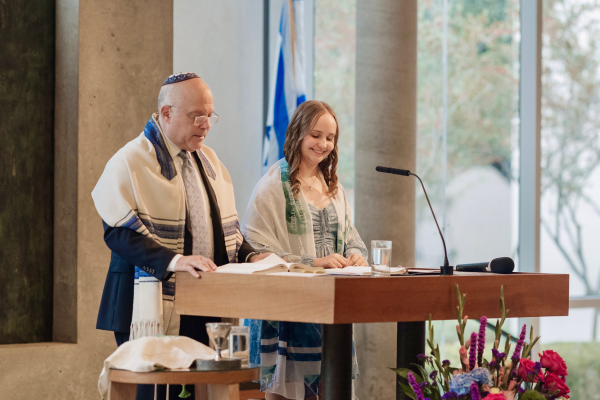
Camilla Martin took that to heart, feeling connected not only to the Torah, but to her family and the responsibility of living a Jewish life. “When I stood on the bimah for my Bat Mitzvah, I felt like I wasn’t standing there alone. I wore the same tallit my grandfather and great uncle wore at their Bar Mitzvah (services), and we had pictures of family at their ceremonies on a table. It made me feel connected to them, and to the generations before me. It wasn’t just my day, it was our family’s tradition continuing, and that made it truly special.”
Becoming a Bar or Bat Mitzvah means standing before God, Torah, and the Jewish people to declare, “I am ready to try to be part of this community in a new and significant way.” It isn’t about a single act or performance; it’s about recognizing that one is now obligated to try. At Temple Shalom, we’ve celebrated students whose physical abilities were limited but whose hearts overflowed with love for Judaism. Their commitment and desire were their truest offering. What they “did” was secondary.
Joshua Neleson’s commitment and desire to try were evident. “By far, the most important part of becoming Bar Mitzvah is to practice.” He added, “You should set aside time to do your work.”
For most students, of course, the “doing” still matters—a lot. They learn to serve as Shaliach Tzibbur, to lead the congregation in prayer, to chant Torah and Haftarah, and to share their D’var Torah. And while every part of that matters, the most breathtaking moment for me is when they become Teachers of Torah. The Torah portion they read has been studied for two thousand years, but their interpretation—what it means to them—has never been heard before in all of Jewish history. That moment, when a young person adds their voice to the eternal conversation of Torah, is sacred and awe-inspiring.
David Falk was able to share his voice, and tie in his celebration theme, baseball, into not only his party, but his D’Var Torah. Sure, his parent surprised him with a video message from the Yankee’s manager, but David shared lessons from the Torah through the lens of baseball. His mother, Michelle, shared that David’s Torah portion touched on the choices we make and the outcomes that come from those choices. “As an example,” David taught, “if I practice baseball regularly, the good consequence would be playing better and earning more playing time. If I skip baseball practice, the bad consequence might be the coach benching me.”
Our task—as Rabbis, Cantors, educators, parents, and friends—is to celebrate that moment with full hearts. To feel pride knowing that another young person has chosen to take their place in the Jewish story, adding their insight and song to our ancient prayers. We plant the seed and stand beside them as they grow into the responsible, connected partners we hope them to be.
Jennie Phon mentioned that one of the most memorable moments of Skyler’s Bat Mitzvah journey was when her Hebrew teacher, Ariella, informed Skyler four days prior that she was not going to be there on the bimah with Skyler. Skyler’s reply was, “It’s okay. I’ve got this.” Her maturity and confidence were evident on the bimah, and I believe that this is a testament to just how incredible Ariella and Rabbi Paley are at guiding, teaching, and preparing these young adults for their special days.
Having a Bar or Bat Mitzvah may be easy. Becoming one is extraordinary.