About two years ago, at the December, 2023 dedication of the Temple Shalom Justice Garden, our neighbor and partner in food justice, Reverend Casey Shobe from the Episcopal Church of the Transfiguration, presented a jar of honey to Rabbi Paley from his personal beehive. Almost as an aside, he offered to help us set up a hive in our garden. Rabbi Paley and the Justice Garden leadership immediately embraced the idea, and this past spring, Temple Shalom’s first beehive was installed.
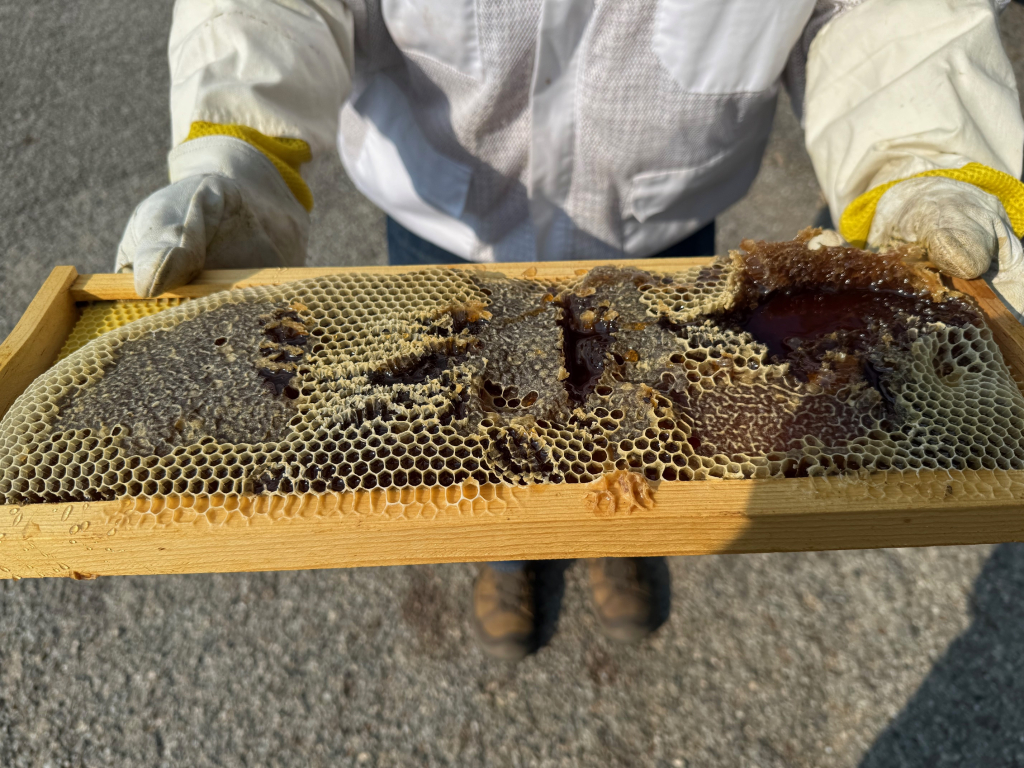
The hive itself is a carefully designed wooden structure containing removable frames, a system first developed in the 1850s to allow beekeepers to inspect and harvest honey without harming the colony. Each frame becomes a canvas for the bees’ extraordinary work, as they build wax honeycomb cells to store nectar that will eventually become honey. Our long-term goal is to have five hives by next year, pollinating within a two to three-mile radius around Temple Shalom, supporting not only our garden, but the broader neighborhood ecosystem as well.
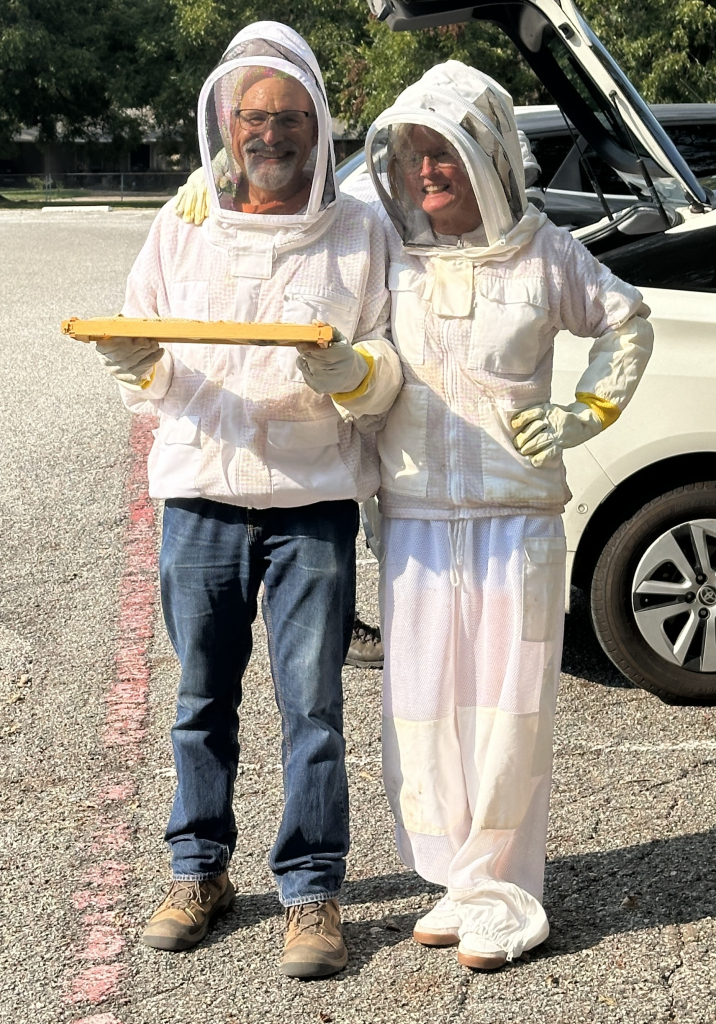
Tending to bees is a special art. Suiting up for our first harvest were Stuart Marcus, Cindy Marcus, and Reverend Shobe, carefully removing the frames and transporting them to the Temple kitchen for extraction with the help of Executive Director David Lamden and our electric honey extractor. The honey they revealed had been months in the making, nectar gathered from thousands of flowers, deposited into cells, gently dehydrated as bees fanned their wings, and finally sealed with beeswax to preserve it for future use.
“While my late wife, Jennifer, sadly never got to see the Justice Garden or the beehives, she was incredibly excited about both,” David Lamden shared. “The minute I started talking about adding hives to our property, Jenn’s amazingly creative brain started thinking about all the possibilities, selling the honey, linking bees and beehives to Jewish history, sharing bee facts in the magazine, even creating bee-themed merchandise for the gift shop.”
In Jenn’s memory, David purchased our second hive and has committed to funding the next three as well. He also donated the electric honey extractor used to separate honey from the combs the bees build on the frames. “I can’t think of a more meaningful way to honor Jenn’s memory than to support something she was so excited about,” he added.
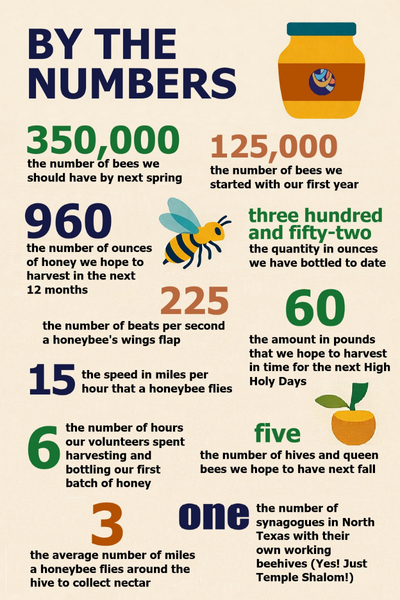
Talk about excitement: Our first harvest in September yielded more than 14 pounds of honey, an extraordinary accomplishment considering that each worker bee produces only about 1/2 of a teaspoon of honey in her lifetime. We proudly shared the harvest with the congregation at Rosh Hashana, a moment made even sweeter by the symbolism of honey as a wish for a good and sweet year. We anticipate two additional harvests before the next High Holy Days and hope to have honey to share with everyone.
Just like the volunteers in our garden, bees are master collaborators. Worker bees, female, tireless, and devoted, handle every task in the hive, foraging for nectar, pollen, and water; caring for larvae; building comb; regulating temperature; and protecting the colony. The queen, the sole egg-layer, serves as the heart of the hive, setting the tone and stability of the entire community. As our sages taught, just as God provides bees with a leader, so too are people guided by righteous leaders.
With construction of our fence underway, the beekeepers (and the board) made the decision to temporarily relocate the hives until their permanent home, further south and closer to Hillcrest, is ready. Once construction is complete, we look forward to hosting a Bee Day, when congregants can decorate the new hives before they are returned to the garden.
Interested in helping with the bees? Contact Stuart Marcus at [email protected].

FAQ ABOUT THE BEEHIVES
Our beehives are wooden structures containing up to ten removable frames, a design developed by Lorenzo Lorraine Langstroth in the 1850s. This system allows beekeepers to inspect the hive and harvest honey without disrupting the colony.
Bees deposit nectar into wax cells, then fan their wings to evaporate excess moisture. Once the nectar becomes honey, the cells are sealed with beeswax. Because bees rely on this honey to survive the winter, we add extra frames to ensure we never take what they need.
Bees carefully regulate hive temperature. In winter, they form a tight cluster and rotate positions to generate heat, keeping the queen’s chamber at about 95 degrees. In summer, they cool the hive by bringing in water and fanning it to create evaporative cooling.
FAQ ABOUT THE BEES
Each hive has one queen, who lays up to 1,000 eggs a day and serves as the stabilizing force of the colony. Worker bees constantly care for her, and her presence determines the hive’s productivity and calm.
A worker bee’s life is best measured in distance, about 500 miles of flying, after which her wings wear out.
Bees release an alarm pheromone that smells like ripe bananas when they sting, attracting others. Beekeepers use smoke to block this signal. Honeybees are generally non-aggressive and sting only to protect their hive.