For more than sixty years, Temple Shalom has been shaped by people who cared deeply about the future.
Long before most of us joined this congregation, volunteers, leaders, clergy, and members made decisions that would benefit people they might never meet. They built programs, expanded our campus, strengthened our finances, and created traditions that continue to enrich Jewish life today.
Because of their vision and commitment, we inherited a thriving congregation.
Now it is our turn.
Over the past several years, many of us have been engaged in conversations about Temple Shalom’s future. Those discussions began with Blueprint 2025, a strategic planning process that helped us better understand who we are as a congregation and what matters most to our community.
As Blueprint 2025 came to a close, we faced an important question: What comes next?
The answer was not simply to create another strategic plan.
Instead, we stepped back and asked a different question:
What future are we responsible for building and sustaining?
That question became the foundation of Blueprint 2030.
Blueprint 2030 is not a president’s plan. It is not a board plan. It is not a staff initiative.
It is a congregational commitment to the future.
One lesson I learned from leading Blueprint 2025 is that organizations can easily lose momentum when priorities shift with every leadership transition. New ideas are important, but lasting impact requires focus, consistency, and patience.
Blueprint 2030 reflects a different approach.
Rather than creating a new vision every few years, we are committing ourselves to a shared roadmap that can guide Temple Shalom through multiple leadership transitions while keeping us focused on the opportunities that matter most.
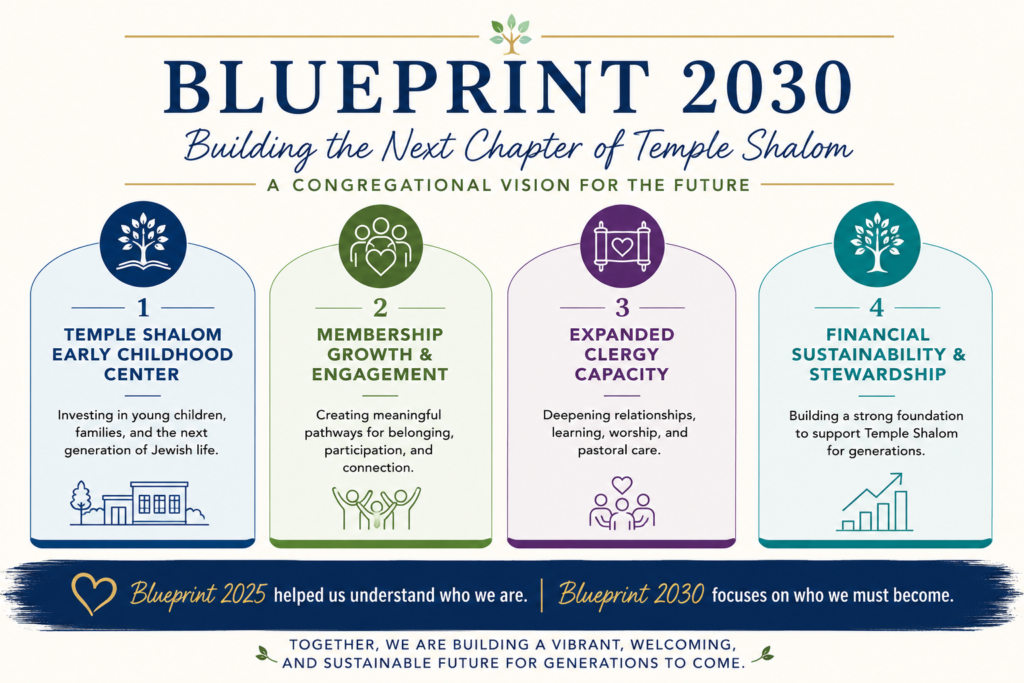
Those opportunities center around four commitments: strengthening our Early Childhood Center, growing membership and engagement, expanding clergy capacity, and ensuring long-term financial sustainability.
These priorities did not emerge overnight. In many ways, they have been part of Temple Shalom’s story for years. What Blueprint 2030 does is bring them together into a clear framework for action.
And the work is already underway.
The opening of the Temple Shalom Early Childhood Center, continued investments in engagement and community-building, growth in endowment support, and efforts to strengthen our long-term financial foundation are all examples of Blueprint 2030 moving from planning into implementation.
But Blueprint 2030 is not ultimately about programs, buildings, or budgets.
It is about people.
It is about creating a Temple Shalom where future generations can find belonging, meaning, learning, friendship, support, and Jewish connection.
Every generation inherits Temple Shalom from those who came before and becomes responsible for those who will come after.
Blueprint 2025 helped us understand who we are.
Blueprint 2030 focuses on who we must become.
Together, we have the opportunity to build a congregation that is vibrant, welcoming, sustainable, and prepared to serve future generations.
The future of Temple Shalom is not something we simply inherit.
It is something we create together.